Coming April 18th, 2026
Naila and the Uprising
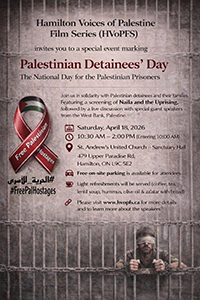
Hamilton Voices of Palestine Film Series (HVoPFS)
invites you to a special event marking
Palestinian Detainees' Day
The National Day for the Palestinian Prisoners
Join us in solidarity with Palestinian detainees and their families.
Featuring a screening of Naila and the Uprising, followed by a live discussion with special guest speakers from West Bank, Palestine.
Saturday, April 18, 2026
10:30 AM – 2:00 PM
St. Andrew’s United Church – Sanctuary Hall
479 Upper Paradise Rd, Hamilton, ON L9C 5E2
Light refreshments will be served (coffee, tea, lentil soup, hummus, olive oil & za’atar with bread)
Watch the trailer of Naila of the Uprising
Register to attend event in person (St. Andrew's United Church)
Register to attend event online (Zoom)
Sponsors:
Synopsis
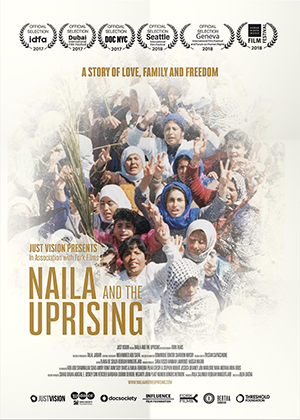 When a nation-wide uprising breaks out in 1987, a woman in Gaza must make a choice between love, family and freedom. Undaunted, she embraces all three, joining a clandestine network of women in a movement that forces the world to recognize the Palestinian right to self-determination for the first time.
The film revolves around the tragic and remarkable story of Naila Ayesh, an active student organizer in Gaza in the 1980s. Naila has spent years building the infrastructure for economic independence for women and self-sufficiency for Palestinians under Israeli occupation. She is pregnant when first arrested in 1986. None of her friends and family knows where she is being detained, and the Israeli army and prison system deny that she is in their custody. After days of torture and interrogation in the prison, she starts bleeding - a sign of a possible miscarriage - but guards ignore her repeated requests to see a doctor.
While the First Intifada provides the backdrop for Naila and the Uprising, its lessons transcend that particular time and place. Through the experience of countless women engaged at all levels of society, we learn what is possible when women take the lead in struggles for rights and justice - from a movement's inception to peace talks - and what we lose when they are stripped of their roles. Echoing struggles around the world, we also witness the tremendous power of nonviolent organizing: women's committees, drawing on all the hallmarks of civil resistance, were able to mobilize hundreds of thousands through massive street rallies, mobile health clinics, underground schools and concerted boycott campaigns, sustaining the uprising while generating indigenous self-sufficiency. In Naila and the Uprising we see how women-led civil resistance can stir the masses, put pressure on power-holders, and affect real structural change.
Naila's husband and long-time partner in activism, Jamal, reaches out to Israeli journalist and activist Roni Ben Efrat, imploring her to look into Naila's case. She works with Israeli journalist Oren Cohen, whose investigation points to clear evidence despite police denials. He publishes just the same. Oren's story hits the headlines, forcing the authorities to reveal that Naila Ayesh is being held by the Shin Bet, Israel's secret service. By the time the bureaucratic machine releases her - without charge - she has lost her child.
 One year later, Naila gives birth to her son Majd, and as the uprising breaks out, she pours her heart into it. Naila and dozens of other women start building parallel institutions to challenge the Israeli military's control of Palestinian life: underground classrooms to replace schools that were shut down by the army, citizen-run health clinics to treat those with no access to hospitals, and "victory gardens" to break reliance on Israeli agriculture.
Naila also orchestrates the secret distribution of leaflets, the underground leadership's communication system to inform people of strikes, boycotts, marches, and other direct actions being planned each week. A new mother, Naila puts baby Majd in a sling and takes him with her at night, hiding the communiqués in loaves of bread.
When her husband is deported for political activities soon after the outbreak of the Intifada, Naila is left to raise a child alone while sustaining her vital role in the uprising. As she gains visibility in the movement, the Israeli authorities arrest her again, this time in the middle of the night, taking her away from her 6-month-old son. With one parent in prison and the other deported, Majd is eventually sent to join his mother and the imprisoned women of the First Intifada, taking his first steps in an Israeli prison yard. Months pass and the uprising persists, leaving the fate of Naila and her family hanging in the balance.
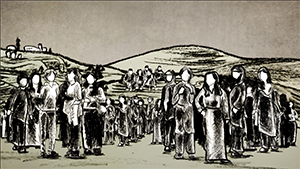
We follow Naila and the women's struggle through the end of the uprising and into negotiations with Israel, where Palestinians are recognized for the first time on the world stage. The women's movement bore immediate fruit, with female activists taking their place on the Palestinian delegation, more female representation than any other party. But will the women be able to carry forward the vision of equality that their activism set in motion?
Using evocative under-camera animation, intimate interviews, and exclusive archival footage, this film brings out of anonymity the courageous women who shook the Israeli occupation and put Palestinians on the map for the first time. Most images of the First Intifada paint an incomplete picture from a law-and-order frame. This film tells the story that history overlooked - of an unbending nonviolent women's movement at the head of Palestine's struggle for freedom.
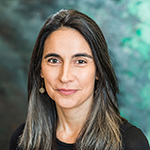
Julia Bacha, Creative Director
Julia Bacha is a Peabody and Guggenheim award-winning filmmaker and the Creative Director at Just Vision, an organization that fills a media gap on Israel-Palestine through independent storytelling and strategic audience engagement. Since graduating Magna Cum Laude and Phi Beta Kappa from Columbia University, she has strategically used documentary film to foster constructive conversations on some of the most divisive issues of our times.
Julia started her filmmaking career in Cairo, where she wrote and edited Control Room (2004), for which she was nominated for the Writer’s Guild of America Award. Control Room became one of the highest-grossing political documentaries of all time and introduced Americans for the first time to the inner workings of the Arab satellite channel, Al Jazeera.
Subsequently, she moved to Jerusalem where she co-directed, wrote, and edited Encounter Point (2006), which followed Palestinians and Israelis who risked their lives and public standing to promote an end to the occupation and the conflict. Encounter Point premiered at the Tribeca Film Festival, won the best documentary prize at the San Francisco Film Festival, and was broadcast on Al Arabiya to millions of viewers.
Julia then directed and produced the critically-acclaimed Budrus (2009), which chronicled the story of a Palestinian community organizer who united all Palestinian factions and Israelis to save his village from destruction by Israel's separation barrier. Hailed in The New York Times as "this year's must-see documentary," the film successfully shifted the way international media covered the protests, as confirmed by an independent media audit by Edelman PR.
Subsequently, Julia directed and produced My Neighbourhood (2012), which follows a Palestinian teenager struggling to reclaim his home in East Jerusalem from Israeli settlers. The film premiered at the Tribeca Film Festival. It was released online by The Guardian, and won the coveted Peabody Award.
Julia also directed Naila and the Uprising (2017), which chronicles the remarkable journey of Naila Ayesh whose story weaves through the most vibrant, nonviolent mobilization in Palestinian history -- the First Intifada. Julia received a Guggenheim Fellowship to produce the film, which had its US premiere at DOC NYC, European Premiere at IDFA, and Middle East Premiere at the Dubai Film Festival. It was broadcast on PBS in 2019 as part of the series Women, War and Peace II, Executive Produced by Abigail Disney.
Most recently, Julia directed Boycott (2021), which documents the efforts of three Americans from diverse backgrounds to protect the right to boycott in America. The film was an official selection at SXSW, HotDocs, and DOC NYC and was covered by CNN, MSNBC, and The New York Times, among others.
In addition to over thirty film festival awards, Julia is the recipient of the King Hussein Leadership Prize, Search for Common Ground Award, Ridenhour Film Prize, DocSociety Creative Impact Award, Chicken & Egg Prize, and Columbia University’s Medal of Excellence.
Originally from Brazil, Julia is a documentary branch member of the Academy of Motion Picture Arts and Sciences.